

Everything in nature moves to a rhythm. The earth circles the sun, the moon circles the earth, plants bloom with the seasons, birds migrate with the light.
Humans are no exception. Every cell and process in your body keeps time. Your hormones, metabolism, cognition, and immunity each follow a daily cadence.
This is your circadian rhythm: the body’s internal clock.
In longevity science, it is emerging as one of the most powerful regulators of healthspan. When it runs smoothly, it protects against drift into dysfunction. When it falters, the fallout touches everything from sleep to metabolism to mood.
TL;DR: Five things you can do today

Circadian rhythm is your body’s 24-hour timing system that coordinates sleep, hormones, metabolism and temperature.

Morning: step outside for light within an hour of waking; no sunglasses.

Day: eat at regular times in daylight; move every few hours.

Late afternoon: keep intense training during this window, or earlier.

Evening: same bedtime routine, 30 minutes of wind-down.

Night: lights low, screens minimal for 1-2 hours before sleep.
What is the circadian rhythm and how does it work?
Think of it as a network of clocks.
- The master clock, or suprachiasmatic nucleus (SCN), sits in the hypothalamus of the brain. It takes its main cue from light entering the eyes, synchronising your biology with the 24-hour day.
- Peripheral clocks exist in almost every organ – liver, gut, heart, pancreas, and muscles. They manage local tasks such as glucose handling, digestion, and immune defence, but ultimately take direction from the brain.
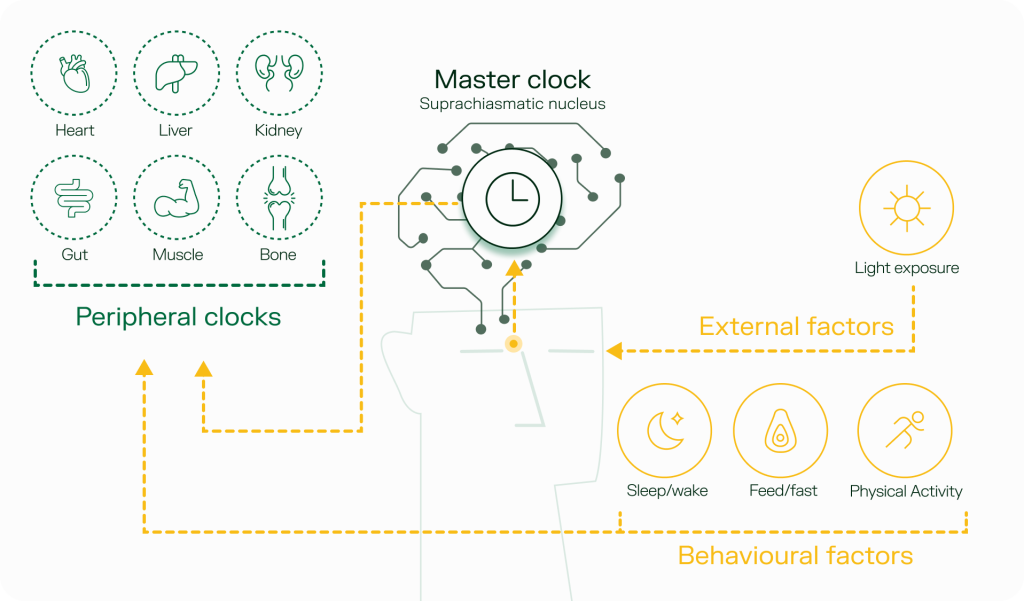
Together, these clocks ensure that the right process happens at the right time – whether that is a pulse of cortisol in the morning to wake you up, or melatonin at night to prepare you for sleep.
How does circadian rhythm develop in babies?
Humans are not born with a fully formed circadian system. The womb shields the foetus from direct light–dark cycles. After birth, the infant slowly learns to sync:
- Melatonin starts appearing consistently by around 3 months, anchoring sleep.
- Cortisol rhythms emerge in the first year, guiding alertness and metabolism.
- Core body temperature stabilises as another reliable marker of timekeeping.
This is how babies transition from erratic, around-the-clock sleep to more predictable cycles. Within four months, the circadian rhythm is firmly at work, laying the foundation for all future biological timing.
Although circadian rhythms are strongly set in childhood, adulthood often disrupts them. Irregular routines, inconsistent sleep, and poorly timed exposure to light or food can shift the body’s internal clock. When these cues, or zeitgebers, are misaligned, the rhythm drifts and biological systems fall out of sync.
What are Zeitgebers and how do they control your body clock
The German word Zeitgeber means “time-giver”. These are the external signals that align our internal circadian clock.
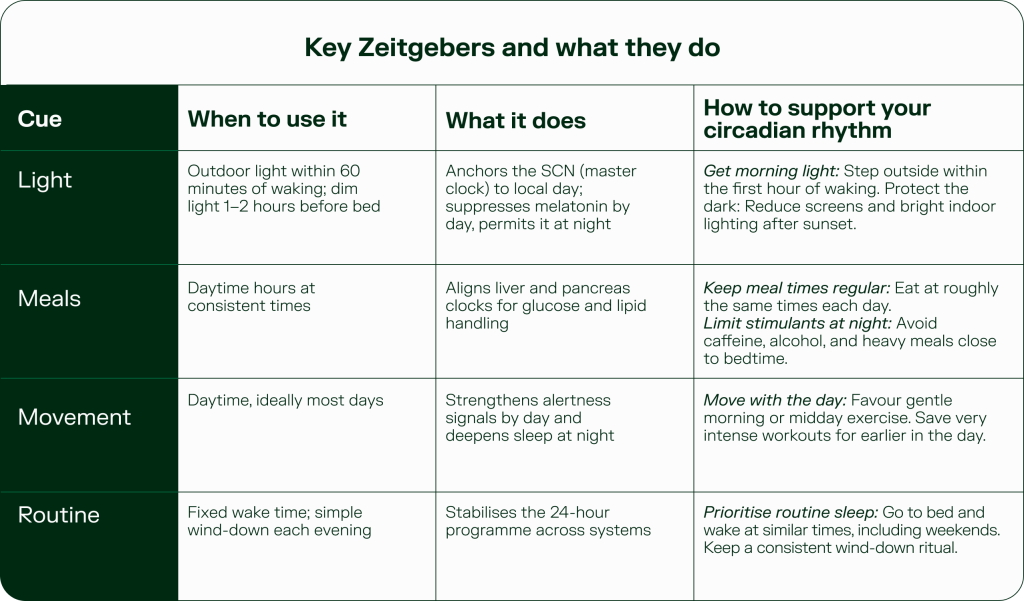
Light is the strongest zeitgeber. When daylight enters the eyes, signals travel to the SCN. In response, the SCN uses the neurotransmitter GABA to suppress the pineal gland from releasing melatonin. This helps keep the body alert during the day. As night falls, the input of light decreases. The SCN’s inhibitory signal fades, allowing the pineal gland to release melatonin into the bloodstream. This shift cues the entire body to prepare for sleep.
Other important Zeitgebers include:
- Food timing: eating on a regular schedule helps set clocks in the liver and gut.
- Movement and social cues: exercise, work patterns, and social interaction also reinforce your body’s timing.
When these cues are stable, the rhythm holds. When they are erratic, the system drifts.
Zeitgebers influencing circadian rhythms
These cues act like anchors, keeping trillions of cellular clocks in sync. Over time, this rhythm builds resilience – not just for sleep, but for metabolic health, mood regulation, and longevity itself.
What causes circadian rhythm disruption?
Circadian disruption is a systemic issue with several common causes:
- Ageing: teenagers naturally run on a later clock, drawn to late nights and slower mornings. With age, the rhythm shifts forward, so older adults often fall asleep and wake earlier.
- Occupation and travel: night-shift workers and frequent flyers constantly fight their biology, raising risk for metabolic and cardiovascular disease.
- Genetics and illness: chronotype (early bird vs night owl) has a genetic component. Misalignment between biology and social schedules can trigger problems. Some conditions, such as depression, autism, or dementia, are closely tied to circadian dysfunction.
- Lifestyle habits: irregular sleep, high caffeine or alcohol intake, lack of daylight, and screen exposure at night all weaken the synchrony of the system.
Why does your circadian rhythm matter for healthspan?
The circadian rhythm is not just about when you sleep. It is the silent conductor of your biology – coordinating temperature, hormones, metabolism, and mood.
When it runs on time, energy is steady, cognition is sharp, and repair mechanisms are strong. When it drifts, the body loses coordination, and the risk of chronic disease rises.
Understanding and protecting this internal timekeeper may be one of the most important – and most overlooked – levers for longevity.
Frequently asked questions (FAQs)

What is the main function of the circadian rhythm?
It aligns your body’s internal processes, such as the sleep-wake cycle, hormone release, and metabolism, with the 24-hour cycle of day and night.

What is the difference between the SCN and peripheral clocks?
The SCN is the master clock in the brain that syncs the entire body to the light–dark cycle. Peripheral clocks are located in individual organs (for example, the liver and heart) and control local functions, taking their primary timing cues from the SCN.

Can you reset your circadian rhythm?
Yes. You can reset your circadian rhythm by managing your exposure to zeitgebers. Key methods include getting bright light exposure in the morning, maintaining a consistent sleep schedule, and timing your meals regularly.

How does light affect melatonin?
Daylight signals the SCN to keep melatonin low. As evening light falls, the signal eases and melatonin rises, preparing you for sleep.

Does meal timing change sleep quality?
Yes. Keeping meals to daytime and avoiding heavy late dinners supports night-time physiology and improves sleep depth.

How long does it take to reset a circadian rhythm?
Most people feel a shift within a few days of consistent cues, although full alignment can take 1 to 2 weeks depending on how out of sync you are.