
The way you sit, stand, and walk, reflects your health, far more than you may realise. Yet, postural health and movement are one of those practices that are most (and subconsciously) overlooked until much later in life – often past the age of 50. Your muscle tone diminishes, bones weaken, and posture declines.
You might argue, “Isn’t that just a normal part of ageing?”
It is. However, this deterioration can be slowed down. All you need is mindfulness, reinforcement, and discipline. With exercises to strengthen your muscles and bones you can preserve mobility and comfort way no matter what your age is.
So, before we get to the “what can you do to correct your posture” – first let’s understand what posture is, how it impacts your systems, and why it matters.
What is posture?
Posture is the alignment of your spine and limbs in everyday positions – how your body holds itself against the constant pull of gravity. It’s not about standing straight; it is about how efficiently your musculoskeletal system bears the load, distributes force, and maintains balance.
There’s more to holding a good posture than just sitting or walking with an erect spine. You need to understand the underlying biomechanics in order to safeguard your musculoskeletal health.
Emerging research increasingly highlights the need to prioritise musculoskeletal health early in life. Your bones and muscles form the structural foundation of posture. But as we age, both undergo changes that make it harder to maintain that foundation. The relationship is bi-directional: poor posture weakens musculoskeletal health, and weak musculoskeletal health reinforces poor posture. With time, there is degeneration of bones (osteopenia) and muscle loss (sarcopenia). Together, they undermine balance and increase injury risk.
The goal is not just to delay age related degeneration, but to prevent it altogether by building strength, alignment, and resilience before dysfunction sets in.
What happens to your bones as you age?
Bone health relies on a dynamic process called bone remodelling; a constant balancing act between two types of cells:
- Osteoblasts: cells that form the bone.
- Osteoclasts: cells that break down the bone.
When you’re young, this balance is well regulated. With age, this equation is disrupted. Three key factors influence bone remodelling:
- Oestrogen and testosterone: Stimulate osteoblast activity; their decline with age slows new bone formation.
- Parathyroid hormone (PTH): Increases osteoclastic activity and reduces calcium in the bones.
- Vitamin D: Helps absorb calcium from food and aids its deposition in the bones.
In addition to hormonal shifts, ageing also affects the bone forming cells, at the cellular level. Ageing cells accumulate reactive oxygen species (ROS) – harmful chemical compounds that reduce osteoblast formation and increase osteoclast activity.
All these changes damage the architecture of the bone, reduce their density (osteopenia) and make them weak (osteoporosis) and easily breakable.
What happens to your muscles as you age?
Muscles give your body strength, stability and control. They allow you to sit upright, walk without effort, and move without injury. But like bone, muscle also undergoes age related decline.
If you don’t maintain movement as you grow older, your muscle fibre will shrink and start deteriorating. And with time, if unattended, it will lead to:
Sarcopenia: The loss of muscle fibre.
Dynapenia: The loss of muscle strength. It is seen in early stages than sarcopenia
The real decline begins when the connection between muscle fibres and motor neurons start to break down. These neurons are responsible for sending signals that tell your muscles how and when to contract.
When this communication becomes faulty, the muscles do not respond efficiently. Nearby neurons may step in to try and help but even they cannot do the job well enough. All this ultimately leads to loss of strength and bulk of the muscle fibre hindering movement, mobility and bad posture.
Weak bones and muscle loss affect postural health
If you’ve gotten this far, you now know the two main pillars of posture: bones and muscle.
Now, as your bones lose strength, they can no longer hold the body uptight during everyday movement. Your spine and knees – two of the body’s major weight bearing structures become very vulnerable. Fractures become more likely. So does chronic pain.
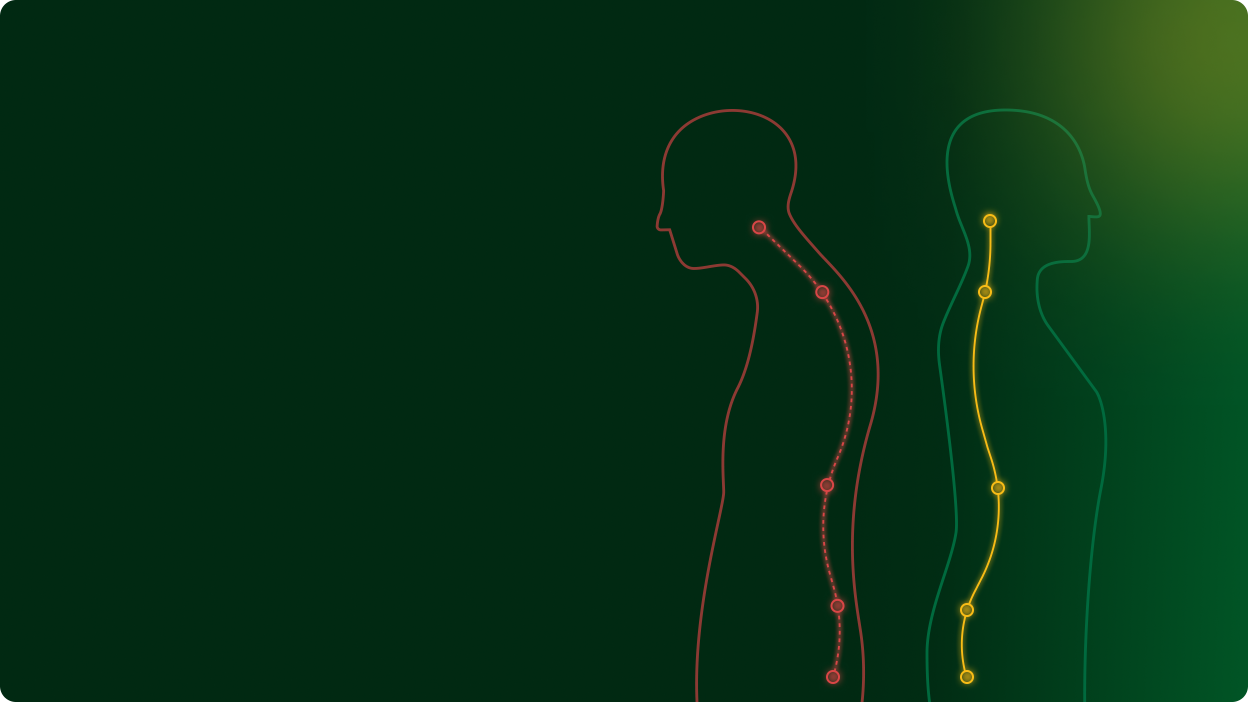
Your vertebrae begin to degenerate, reducing spinal height and compressing the spinal column. As this happens, the natural S-shaped curve of the spine begins to flatten and collapse – leading to a hunched back.
Add weakened muscles to the mix, and the effect intensifies. Without muscular support, the body starts to lean, shift, or compensate, creating poor movement patterns that gradually lock into place. As posture worsens, so does mobility; chronic back pain and abnormal gait, how you walk – become part of your daily reality.
Mindful posture adjustments
Good posture means your spine retains its natural S-shaped curve without distortion or strain. Your spine is upright – not hunched, slouched or hyperextended. The surrounding muscles, bones and joints work as a support system, holding the spine in place, and sharing its load.
Maintaining a good posture is not passive. It depends on the active coordinated function of your entire body – spine, muscles, joints, and nervous system. When these functions are in sync, it reduces pressure on the body, preserves mobility, and prevents early wear and tear.
What is bad posture?
Slipping into a bad posture occasionally – after a long day at work or strenuous workout is normal. Your shoulders naturally droop forward or your back rounds slightly. However, prolonged periods of being in this position is what causes harm. The problem begins when that posture becomes your default posture. Over time, your body adapts to this misalignment compensating in ways that strain muscles, joints and ligaments.
A group of researchers in Japan investigated the long term effects of kyphosis (commonly caused by poor posture), on independence, quality of life, and death rates. The results are shocking. People with poor posture not only lost their ability to move around on their own, or stay independent, but the death rates were also high, compared to those without spinal curvature issues.
Another study throws light on how sedentary lifestyle and improper posture maintenance affect physical health at a cellular level. Bad posture increases oxidative stress in the mitochondria and other organelles in the cell. It results in hastening the ageing process, leading to increased muscle and bone loss.
It’s a chain reaction: Postural issues→ compromised musculoskeletal health→ reduced mobility→ sedentary lifestyle→ lifestyle disorders→ poor health→ faster biological ageing
The earlier this decline begins, the harder it becomes to reverse.
What happens when you slouch?
Blame the chairs in work set-ups or the tables and benches in schools. It’s very rare that they are ergonomically designed to support the spine. The effect and the impact?
Unless you’re already doing things right, we often slouch while working on our laptops, affecting postural health.
Are you a sloucher?
Here’s what you need to watch out for:
- Shallow breathing: When you slouch, you unnecessarily stretch your spinal muscles. This restricts expansion of the chest leading to difficulty in breathing; causing a drop in blood oxygen levels.
- Lack of focus: Low oxygen levels and poor circulation disrupts cognitive performance. Eventually, leading to foggy thinking, low concentration, and disturbed sleep cycles.
- Pain and stiffness: When you slouch, your head shifts forward, increasing the load on your cervical spine. With every few degrees of forward tilt, the weight on your neck multiplies. This sustained strain leads to muscle stiffness, upper back pain, neck pain, and spinal fatigue.
- Dysregulated digestive system: Sitting in an improper position for a long time compresses the abdominal cavity, impairing circulation and digestive mobility. This results in faulty digestion – leading to dyspepsia and constipation, and gastric reflux.
- Postural damage: Long term slouching encourages a kyphotic posture – also known as a hunchback. With age, it changes not just how you sit, but how you walk, stand, and carry yourself.
How daily habits can change your postural health
Improving and correcting posture does not require extensive lifestyle changes, nor do you have to go out of the way to incorporate them. Simple and small practical changes in the daily routine can bring about a sustained, positive impact.
You’ve likely heard the advice since childhood – ‘Sit properly’, ‘keep the back straight’, ‘look forward’. It’s time we start taking that seriously, and executing with intent.
Start with your workspace
If your job involves long hours of sitting – you’re spending much of your precious time there. Don’t take that space lightly. A well designed, ergonomic setup reduces unnecessary strain and helps reinforce better posture throughout the day.
What to look for in an ergonomic chair:
- Firm lumbar support to protect the natural curve of your lower back
- Breathable material to avoid stiffness and overheating
- Armrests that support your elbows without raising your shoulders
This is how you should adjust your posture:
- Your eyes should be level with the top third of your screen.
- Your wrists should stay neutral – not bent, when using a keyboard or mouse.
- Your feet should be flat on the ground (or a footrest), not dangling, not cross folded on the chair (single or both legs).
Now, your personal space
How you carry yourself when you’re relaxing matters just as much as your workspace. Whether you’re sinking into a sofa, walking around the house, or collapsing into bed after a long day – your body continues to form habits.
Slouching while scrolling, leaning while brushing, lounging at odd angles – these small lapses, repeated often, begin to shape your spine and strain your muscles.
The goal isn’t to be rigid, it’s to be mindful. Your posture should adapt with ease across all settings.
Can exercise reverse the damage of poor posture?
Yes – depends on your existing conditions or symptoms, but it most definitely can help keep your body functioning, for longer – if done consistently. Exercise challenges how the muscles and bones respond to ageing. It makes the bones and muscles strong and slows the process of ageing.
When done consistently, the right type of movement does three powerful things:
- It reduces oxidative stress inside muscle fibres – protecting them from age related breakdown.
- It stimulates muscle protein synthesis, supporting growth, strength, and repair.
- It enhances mitochondrial biogenesis, helping your body generate more cellular energy, improving endurance, and boosting exercise tolerance.
Where should you start?
If you’re new to movement or returning after a break, don’t jump into intense routines. Take it easy. Focus first on:
- Exercises that strengthen your core – to support the spine and pelvis
- Mobility based exercises to loosen the joints and muscles
- Movements that improve spinal stability – to restore alignment and balance
- Resistance training that builds both muscle mass and bone density
Even simple bodyweight routines, when done consistently, can help correct imbalances and restore strength.
Moreover, when posture correction exercises are done mindfully, your muscles create a muscle memory that helps rectify the damage and maintain postural health.
Can diet influence postural health?
Not directly. But diet plays a foundational role in supporting the very systems that hold your posture together – your muscles, bones, and connective tissues. Just like movement reinforces structure, nutrition fuels that structure from within. Think of it as the invisible scaffolding your body builds every day, based on what you feed it.
Protein intake for the muscle
Muscles need protein to grow, repair, and retain strength. One group of amino acids in particular: branched-chain amino acids (BCAAs) like leucine, has been shown to support muscle synthesis and prevent breakdown.
How much do you need?
The general recommended dietary allowance (RDA) for protein is 0.8 grams per kilogram of body weight per day. This is the baseline number. Your needs vary depending on the age, sex, stress, and physical activity.
Calcium and vitamin D for the bones
Calcium gives bones their structure. Without it, your skeleton loses strength and density. Vitamin D works alongside it, helping your body absorb and use calcium efficiently.
Natural sources of calcium include:
- Dairy products like milk and yoghurt
- Soy based foods
- Seeds such as sesame
- Nuts like almonds
One thing to remember: even if your diet contains enough calcium, a deficiency in vitamin D can prevent proper absorption. And with most of us working indoors – sunlight exposure must be a planned activity. An early morning sunlight exposure for- at least 15 to 20 minutes daily will help the body synthesise vitamin D.
How much do you need?
- Adults aged 19 to 50: up to 1000 mg of calcium per day
- Adults aged 51 and above: 1200 mg per day
Posture is a lifelong habit
Musculoskeletal health and postural health are deeply interconnected. One shapes the other. Small, consistent lifestyle changes, like being mindful of how you sit, stand, move, and rest – can go a long way. A good starting point? Paying attention to the alignment between your spine and the rest of your body, in every posture you adopt.
If we do not take care of ourselves now, it only gets harder later.
Not just to move, but to recover.
Not just to stand tall, but to stay strong.